
What Is the Difference Between a Freight Broker, Freight Broker Agent and a Dispatcher
Jan 14, 2026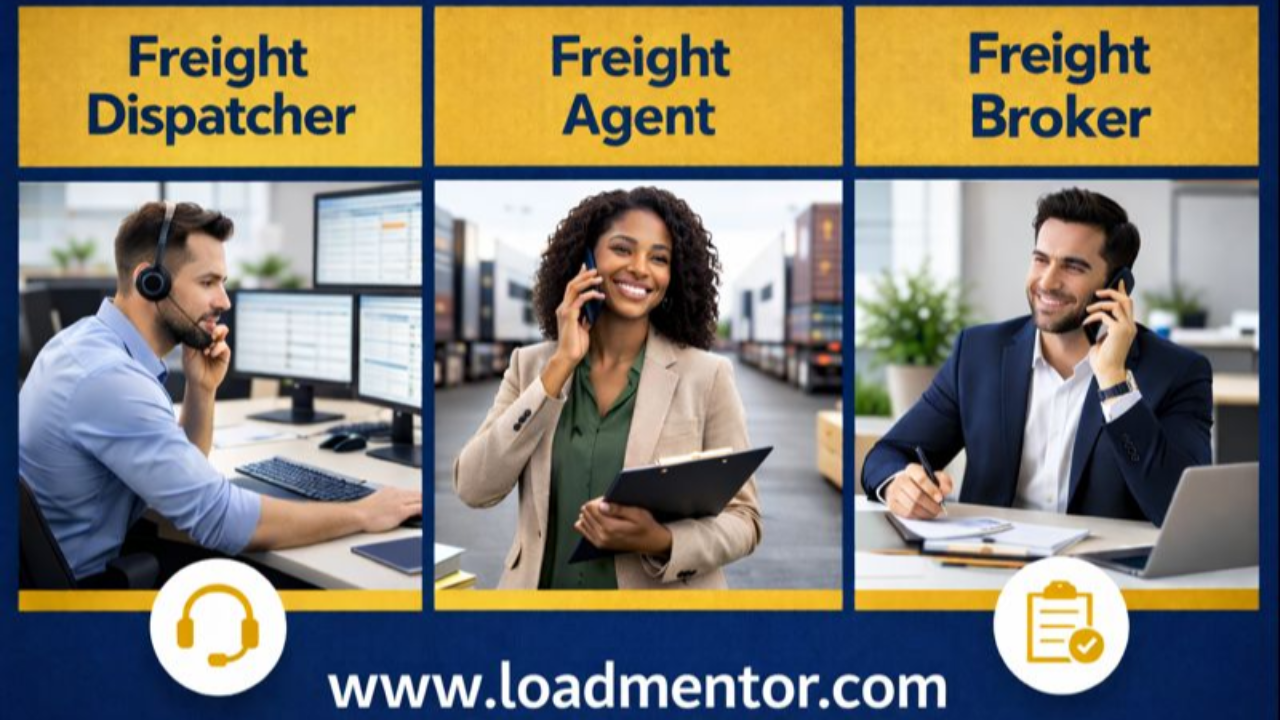
Freight Broker vs. Agent vs. Dispatcher: Finding Your Best Path in Logistics
Choosing a career in logistics is about more than just ambition. It is about alignment.
Freight brokers, dispatchers, and freight agents often interact with the same freight, the same carriers, and sometimes the same shippers. To the outsider, the activities look similar. But to the professional, the difference lies in control, accountability, and leverage.
This article compares these three roles from an operational reality rather than theory. The goal is to help you understand where your strengths fit best so you can build a sustainable career.
Why Role Clarity Drives Success
Many people enter logistics by chasing the option that looks the fastest. However, long-term success comes from matching your personal strengths to the right business model.
When you align your skills with the right role, you gain:
-
Clarity on your daily responsibilities.
-
Confidence in your regulatory standing.
-
Momentum because you are not fighting against the structure of the industry.
Roles in logistics are designed to distribute responsibility efficiently. Understanding that distribution is your first step toward building a business that lasts.
1. Dispatch Services: The Operational Specialists
Core Function: Execution and Support.
Dispatch services exist to support carriers.
In practice, dispatchers are most effective when they focus on execution after a carrier has already committed to a load. Their value comes from organization. They coordinate schedules, manage communication, and help drivers keep moving efficiently.
Where Dispatching Shines Dispatching is perfect for those who enjoy the fast-paced, operational side of logistics. It works best when you view yourself as an extension of the carrier, helping them maximize their hours and revenue.
For a detailed explanation of dispatch boundaries, see [Dispatch Services Explained].
2. Freight Agents: Building with Leverage
Core Function: Relationships and Sales.
Freight agents operate in the sweet spot between employment and full ownership.
In real terms, agency work allows you to build a book of business and manage freight without the burden of holding your own authority. It removes the administrative weight. Agents get to see how freight is priced, how relationships are built, and how problems are resolved, all while utilizing the back-office support of an established brokerage.
Where Agency Shines This role is ideal for professionals who want to focus on revenue generation rather than regulatory compliance. It offers a path to high income and independence without the initial capital requirements of a standalone brokerage.
For a full explanation of the agent role, see [What Freight Agents Do].
3. Freight Brokers: Total Ownership
Core Function: Strategy and Accountability.
Freight brokers are the architects of the transaction.
Once you hold your own authority, you become the point of accountability. This is not just sales. It is ownership. Brokers control the flow of freight, the selection of carriers, and the financial structure of the deal.
Where Brokerage Shines This path is for those who want to build an asset. It brings the highest level of control and the highest potential upside, but it requires a willingness to manage the full scope of business operations, from claims to cash flow.
For a deeper look at brokerage responsibility, see [What a Freight Broker Actually Does].
Comparison at a Glance
Here is how the roles stack up based on day-to-day reality:
The Dispatcher
-
Controls Freight: No (The Carrier decides)
-
Primary Focus: Execution & Scheduling
-
Best For: Operational thinkers who love helping drivers.
The Freight Agent
-
Controls Freight: Yes (Under a Broker’s Authority)
-
Primary Focus: Relationships & Sales
-
Best For: Entrepreneurs who want to scale without overhead.
The Freight Broker
-
Controls Freight: Yes (Owns the Authority)
-
Primary Focus: Full Business Management
-
Best For: Those ready to build and manage a complete system.
How Experienced Professionals Choose
Instead of asking "Which role pays the most?" consider asking:
-
Do I want to manage execution (Dispatch), relationships (Agent), or the full system (Broker)?
-
Am I ready to manage the cash flow and compliance of a full authority?
-
Do I want to start building today (Agent) or spend time setting up infrastructure (Broker)?
Common Paths to Success
There is no single correct path. Experience shows that many successful logistics professionals follow a progression:
-
Starting as a Dispatcher to learn the carrier side.
-
Moving to Agency to master sales and freight flow.
-
Eventually becoming a Broker once they have a book of business and capital reserves.
Success happens when you respect the process and choose the role that matches your current capacity.
Find Your Fit Before You Commit
Dispatchers manage execution. Agents manage relationships. Brokers manage outcomes.
The correct path is rarely the fastest one. It is the one that allows you to perform at your best.
Are you still deciding which path is right for you?
I have created a specific tool to help you make this decision with data, not just intuition.
-
The Skills Inventory: A guide to map your personality and experience to the right logistics role.
-
The Startup Cost Calculator: See the financial difference between starting as an Agent vs. a Broker.
[Download the Freight Broker Launch Toolkit here]
Stay connected with news and updates!
Join our mailing list to receive the latest news and updates from our team.
Don't worry, your information will not be shared.
We hate SPAM. We will never sell your information, for any reason.